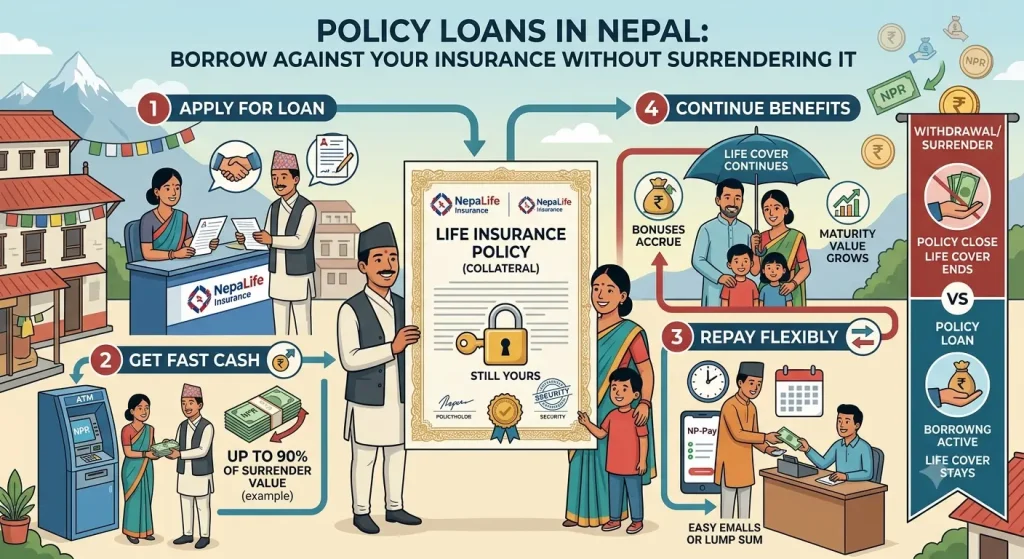
If you have an endowment or whole-life policy in Nepal and you suddenly need cash, you have an option most people forget they own: you can borrow against the policy itself, without cancelling it and without losing the years of premiums you have already paid. It is called a policy loan, and for a policyholder in a tight spot it is almost always a smarter move than surrendering. Here is how it works, how it compares to a bank loan, and what it does to your eventual payout.
What a policy loan is (and what it is not)
A policy loan lets you borrow money from your insurer using your own policy as security. The loan is drawn against your policy’s surrender value, which is the cash value your savings-type policy has built up over the years you have been paying premiums. The insurer lends you a share of that value and charges interest on it.
What it is not: it is not a withdrawal, and it is not the insurer “giving back” your money. Your policy stays fully in force the entire time. Your life cover continues, your bonuses keep accruing, and the policy still matures normally. You have simply taken a loan secured by the value sitting inside it. That is the whole reason it beats surrendering, which we come back to below.
Only savings-type policies qualify
This is the first thing to check. A policy loan needs surrender value to borrow against, and only savings-type plans build that value:
- Endowment, whole-life, and money-back plans accumulate surrender value, so they can support a policy loan once that value exists.
- Pure term plans have no surrender value at all. They are protection only, so there is nothing to borrow against and no policy loan is possible. (If you are unsure which type you own, our term vs endowment guide explains the difference.)
Surrender value does not appear immediately either. Under Nepal’s life insurance rules (the Beema Samiti / Nepal Insurance Authority directive), a policy acquires surrender value only after you have completed 3 full policy years and paid 3 full annual premiums. Before that, the policy has no surrender value and you cannot borrow against it. Once it does, you can typically borrow up to 90% of the surrender value (some plans cap the loan at the lower of 90% of surrender value, or 25% of the sum assured plus accrued bonus). Our surrender value calculator gives a rough estimate of where your policy stands before you ask a branch for the exact loan figure.
Why it beats a bank loan
For a short-term cash need, borrowing against your policy has real advantages over walking into a bank:
- No credit check. The insurer is lending against value you have already deposited, so your credit history and CIB record are irrelevant.
- No collateral hunt. Your policy is the collateral. You do not need to pledge land, a vehicle, or a guarantor.
- No rigid EMI. Policy loans are far more flexible than a bank loan’s fixed monthly instalment. You can usually repay at your own pace, in part or in full, as long as the loan plus interest stays within your policy’s value.
- Fast and low-friction. Because the security already exists inside the policy, approval is usually quick compared with a fresh bank loan application.
The trade-off is interest. The insurer charges interest on the outstanding loan, and that interest keeps accruing until you repay. It is not free money. But for a genuine short-term need, it is typically cheaper and far quicker than the alternatives, and far less damaging than surrendering the policy.
How the loan affects your payout
This is the part people miss, so read it twice. Whatever you have not repaid does not simply disappear. The outstanding loan plus accrued interest is deducted from your policy’s payout.
- If the policy matures while a loan is outstanding, the insurer subtracts the loan and interest from your maturity amount and pays you the balance.
- If you die while a loan is outstanding, the insurer deducts the loan and interest from the death benefit before paying your nominee. Your family receives less than the full sum assured. This is exactly why an outstanding loan matters at claim time, and it is one of the deductions to be aware of when you read our guide to claiming life insurance in Nepal.
None of this is a penalty. It is just the loan being settled out of money the policy was always going to pay. But it means a policy loan you forget about quietly shrinks the protection your family is counting on.
What happens if you never repay it
You are not obligated to repay on a fixed schedule, but ignoring the loan forever has a limit. Interest keeps compounding on the unpaid balance. As long as the loan plus accumulated interest stays below your policy’s surrender value, the policy survives. The danger point is when the outstanding loan and interest grow to exceed the surrender value: at that stage the insurer can foreclose and the policy can lapse, wiping out your cover. The practical rule is simple: treat the interest seriously even if you treat the principal flexibly, and do not let the loan run unchecked for years.
Not sure which plan fits you? Answer 5 questions and get a personalised match.
Find My Plan →How to apply at your insurer’s branch
The process is straightforward and handled directly with the insurer (for example at a Nepal Life or LIC Nepal branch), not through a third party:
- Confirm your policy has enough surrender value to borrow against (use the surrender calculator for a rough idea first).
- Visit your insurer’s branch with your original policy document and a valid photo ID.
- Request a loan against the policy. The branch calculates the maximum you can draw based on the current surrender value.
- Sign the loan agreement, which assigns the policy to the insurer as security for the loan.
- The funds are disbursed, and the loan plus interest sits against your policy until you repay it or it is settled from your payout.
Policy loan vs surrender: do not confuse them
When money is tight, many policyholders’ first instinct is to surrender the policy and take the cash. That is usually the worst available choice. Surrendering ends your cover permanently, locks in a loss on the value you have built, and throws away years of bonus compounding. A policy loan lets you raise cash from the same surrender value while keeping the policy alive, so your cover and your maturity benefit continue intact. Before you ever consider surrendering, check what you could borrow instead with the surrender value calculator.
Quick answers
Can I take a policy loan on a term plan?
No. Term plans have no surrender value, so there is nothing to borrow against. Policy loans are only available on savings-type plans (endowment, whole-life, money-back) once they have built up value.
Does taking a policy loan reduce my life cover?
Not while the loan is outstanding and unsettled, but at claim or maturity the unpaid loan plus interest is deducted from the payout. So in effect, an unrepaid loan reduces what your family or you finally receive.
How soon after buying can I take a loan?
Only once the policy has acquired surrender value. Under Nepal’s rules that means after you have completed 3 full policy years and paid 3 full annual premiums. A newer policy has nothing to lend against yet.
Is the interest on a policy loan high?
The insurer sets the rate and charges it on the outstanding balance. It is typically more reasonable than an unsecured bank loan because the loan is fully secured by your own policy, but it is real interest that compounds, so do not ignore it.
Know what your policy is worth first
A policy loan is only as useful as the value your policy has built, and that value depends on the plan you bought and how long you have paid into it. If you are still choosing a policy, or want to see how savings-type plans build value over time, compare the insurers on claim settlement, bonuses, and financial strength before you commit. The premiums you pay today are what create the cushion you can borrow against tomorrow, as we explain in life insurance premiums in Nepal explained.
Independent and free. We don’t sell policies. We help you understand them.