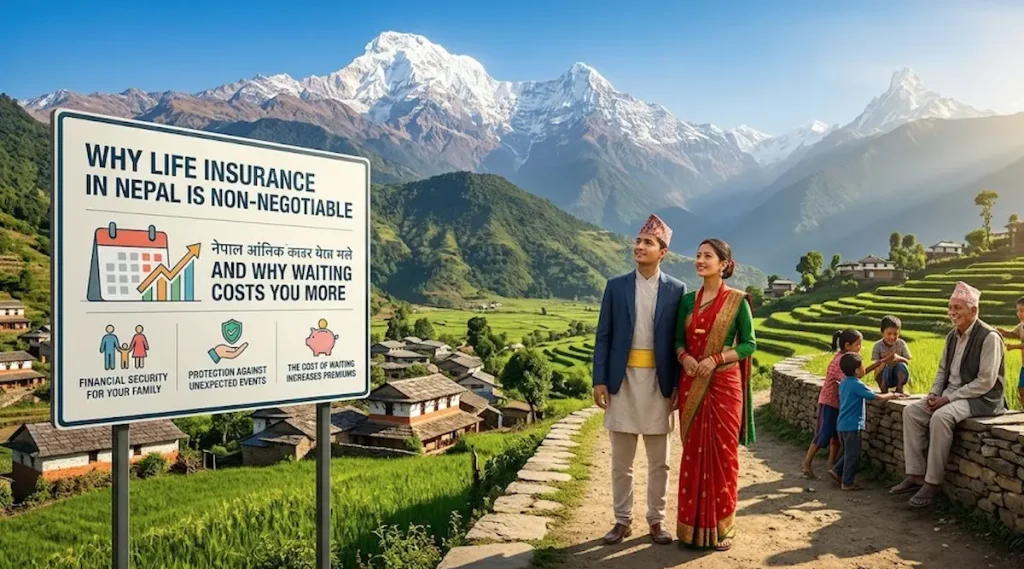
Most Nepalis know they should have life insurance. Very few understand why — beyond the vague idea that “something might happen.” That gap between knowing and understanding is exactly why so many families end up with inadequate cover, or none at all.
This guide explains the real case for life insurance in Nepal: what it protects, why the government cannot do that job for you, and why every year you delay makes cover harder and more expensive to get.
What Your Life Is Actually Worth to Your Dependents
Here is a number most people never calculate: the total income your family depends on you to earn over the rest of your working life.
If you are 30 years old earning NPR 40,000 per month, and you plan to work until 60, your family is depending on:
NPR 40,000 × 12 months × 30 years = NPR 1.44 crore
That is the financial value your life represents to your dependents — what economists call the human life value. If you die without insurance, that NPR 1.44 crore disappears. Your family does not just grieve; they face a financial crisis, often within months.
Life insurance exists to replace that income. Not to make death profitable — to prevent it from being a financial catastrophe.
A Simple Benchmark for How Much Cover You Need
A common starting point: your sum assured should equal 10 to 15 times your annual income. At NPR 40,000 per month, that means NPR 48 lakh to NPR 72 lakh in coverage. Most Nepalese policies are written for far less. If your current policy is for NPR 5 lakh or NPR 10 lakh, it replaces months of income — not years.
Not sure where to start? Calculate a sum assured that actually matches your income and family size.
Why Nepal’s Safety Net Makes Private Insurance Critical
In countries with mature social security systems, the government provides a baseline: unemployment benefits, survivor pensions, subsidized healthcare. Families lose income when a breadwinner dies, but not everything at once.
Nepal does not have that baseline for most workers.
What exists:
- The Employees’ Provident Fund (EPF/CNPF) covers formal, salaried employees — a minority of Nepal’s total workforce. The large majority of Nepalese workers are in informal employment, daily wage work, farming, or self-employment, and receive no EPF coverage.
- The Social Security Fund (SSF) is expanding, but payouts remain modest and coverage is far from universal. What does not exist:
- A survivor’s pension for the widow or widower of an informal worker
- Government-funded income replacement for self-employed people, farmers, daily wage earners, or migrant workers’ families If you work in construction, run a small business, drive a taxi, or send remittances from abroad, there is no government programme that will protect your family’s income when you are gone. Life insurance is not one option among several — for most Nepalese, it is the only option.
The Cost of Waiting: Why Every Year Matters
People delay buying insurance for three reasons: it feels like an unnecessary expense today, death feels abstract, and there is always “next year.”
Each of those years carries a real, compounding price.
Premiums Rise with Age
Life insurance premiums in Nepal are calculated primarily on your age at entry. The older you are when you buy, the higher your annual premium for the same sum assured — locked in for the entire policy term.
Here is what that looks like in practice for a 20-year endowment policy with NPR 25 lakh sum assured:
Not sure which plan fits you? Answer 5 questions and get a personalised match.
Find My Plan →┌──────────────┬──────────────────────────┐
│ Age at entry │ Annual premium (approx.) │
├──────────────┼──────────────────────────┤
│ 25 years │ NPR 1,12,000 – 1,17,000 │
├──────────────┼──────────────────────────┤
│ 35 years │ NPR 1,32,000 – 1,38,000 │
└──────────────┴──────────────────────────┘
A 35-year-old pays roughly 18% more per year than a 25-year-old for identical cover. That difference runs for 20 years of premium payments — it adds up to several lakh rupees over the life of the policy.
See exactly how age affects your premium— and use the calculator to run your own numbers.
Eligibility Closes with Age and Health
Most Nepal life insurance companies cap new policy issuance at age 60–65. Some plans have lower entry limits. If you develop a health condition before you buy — diabetes, hypertension, cardiac issues — the insurer may decline your application or add a permanent premium loading.
Waiting does not just cost you more money. It risks losing eligibility entirely.
The Window After a Diagnosis Shuts Fast
Health disclosure is mandatory in Nepal. If you develop a chronic condition and then apply for insurance, the insurer will either decline, load the premium significantly, or exclude that condition from coverage entirely. The time to buy insurance is before you need it — when you are healthy and the insurer wants your business.
Insurance as Wealth Preservation, Not an Expense
There is a mental model that prevents many Nepalese from buying adequate insurance: the idea that premiums are money “thrown away” if you do not die during the policy term.
This is a category error. Consider what an endowment or savings-linked policy actually does:
- Pays a death benefit if you die during the policy term — protecting your family immediately
- Returns your sum assured plus accumulated bonuses if you survive to maturity — your money comes back, with a return on top
- Builds a forced savings habit — the annual premium is money you cannot spend impulsively, set aside and growing each year
- Can serve as loan collateral — policy loans against your Nepal life insurance require no credit check, no additional collateral, and carry interest rates substantially below what banks charge for personal loans An endowment plan is not pure insurance in the traditional sense. It is a hybrid: protection combined with disciplined saving and a guaranteed payout at maturity. For many Nepalese households who do not invest systematically in any other asset class, the insurance premium is their primary wealth-building vehicle. The question is not “what do I get if I don’t die?” The question is “what does my family lose if I do?”
Where to Start
If you have never bought life insurance — or if you bought a small policy years ago and have not reviewed it since — the clearest starting point is not picking a company. It is verifying that you have the right amount of cover.
Most people are under-insured, not uninsured. A NPR 5 lakh policy on a family whose breadwinner earns NPR 50,000 per month covers 8 months of income. That is not a safety net — it is a gesture.
Work out the number your family actually needs. Then compare all 14 NIA-licensed insurers side by side to find the plan that fits your budget and preferred term length.
The Bottom Line
Life insurance in Nepal is non-negotiable for one reason: there is nothing else.
No government programme replaces the income of an informal worker’s family. No savings account survives 20 years of educational expenses on a single remaining income. No relative can absorb the full financial shock that comes when the household’s primary earner is gone without warning.
Waiting until “the right time” is the most expensive decision you can make. The right time was last year. The second-best time is now.
Compare all 14 NIA-licensed insurers — free, no signup required.