Analysis of Bonus Rate 80/81 and Expected Bonus Rates for 81/82
As the Nepalese financial sector navigates the complexities of the 2083 Bikram Sambat (BS) fiscal landscape, the life insurance industry remains a foundational pillar of long-term domestic capital formation, infrastructure financing, and household wealth preservation. The declaration of annual bonus rates by life insurance companies serves as a highly scrutinized barometer for institutional health, actuarial precision, and the broader macroeconomic investment climate within the country.
This comprehensive report examines the officially approved life insurance bonus rates for the fiscal year 2080/81 and analyzes the expected bonus rate trajectory for the closing 2081/82 fiscal year. Out of the fourteen operational life insurance companies currently licensed by the Nepal Insurance Authority (NIA), all fourteen have successfully published their approved bonus distribution structures for the 2080/81 cycle, including the state-owned Rastriya Jeevan Beema. These recently approved figures act as the mandatory interim rates for the 2081/82 period until new actuarial valuations are finalized.
Guardian Insight: At nepallifeinsurance.com, we have utilized Advanced AI to synthesize audited data from all 14 insurers, ensuring this report provides the most accurate cross-market comparison available in Nepal today.
The macroeconomic environment is characterized by aggressive state-led development initiatives that directly influence the asset-liability matching strategies of life insurers. The Government Policies and Programs for 2083 outline a transformative roadmap shifting toward a digital, green, and self-reliant economy, anchored by a national budget size of NPR 1,964.11 billion. To achieve a targeted 7% annual economic growth rate and transition Nepal into a middle-income country, the government is focusing heavily on resolving cooperative crises, establishing Depositors’ Protection Funds, and directing capital toward green energy. Most critically for life insurers, the state has established a massive target of 30,000 Megawatts (MW) of electricity production within a decade.
The Actuarial Framework and Regulatory Environment
The Mechanics of Surplus Generation and Reversionary Bonuses
In the Nepalese insurance market, the vast majority of retail life policies are participating, meaning they contractually entitle the policyholder to a proportionate share of the insurer’s distributable surplus. This surplus is generated through three primary actuarial channels: the interest surplus, the mortality surplus, and the expense surplus.
The interest surplus represents the positive differential between the assumed actuarial discount rate utilized during product pricing and the actual investment returns generated from the insurer’s asset portfolio. Given the long duration of life insurance liabilities, insurers heavily favor fixed-income securities and infrastructure debentures that offer a premium over standard savings rates. The mortality surplus is derived from the variance between the projected mortality rates, which are based on national mortality tables, and the actual demographic claims experience of the insurer’s specific risk pool. Finally, the expense surplus represents the margin of savings achieved when actual operational and administrative expenditures are lower than the expense loadings priced into the gross premiums.
At the conclusion of each fiscal year, an appointed independent actuary evaluates these parameters to calculate the life fund’s overall surplus. The operational costs associated with running these massive funds can be substantial, making expense management critically important to maximizing the distributable surplus. Following the calculation of the surplus and subsequent approval from the Nepal Insurance Authority, the surplus is distributed to participating policyholders in the form of a reversionary bonus, expressed as a specific nominal currency amount per NPR 1,000 of the Sum Assured. You can estimate your own potential returns using our Insurance Premium Calculator.
Risk-Based Capital and Regulatory Oversight
The Nepal Insurance Authority has implemented increasingly stringent guidelines to ensure the long-term solvency of insurers, transitioning the market toward a risk-based capital framework. According to these directives, insurers must continuously comply with regulations on technical provisions and maintain appropriate capital requirements that accurately reflect the specific risk profile and approved risk tolerance limits of the business.
The regulatory framework explicitly mandates that life insurers must use the technical reserve derived from the best estimate liability and a margin over best estimates, strictly without relying on transitional provisions, for the primary declaration of bonuses. While the Authority may accept policyholder bonus calculations based on surplus calculated using transitional provisions if explicitly recommended by the insurer’s appointed actuary, the actuary bears the ultimate fiduciary burden to guarantee that any declared bonus leveraging such transitional benefits is mathematically sustainable over the long term.
Tax Incentives and the Enhancement of Effective Yields
When evaluating the comparative return on investment of life insurance in Nepal, the nominal bonus rates declared by the companies must be analyzed in conjunction with national fiscal policies and individual taxation frameworks. The prevailing tax code provides significant, targeted incentives designed to encourage long-term domestic savings and health risk mitigation.
According to the updated fiscal provisions, a resident natural person who has procured life insurance and paid the premium amount is legally entitled to a tax deduction from their taxable income equal to the lower of the actual annual insurance premium paid or NPR 40,000. Furthermore, a separate, distinct deduction up to NPR 20,000 is available for health and medical insurance premiums paid to a resident insurer.
For policyholders operating within the middle to upper-income brackets, which are typically subject to 20 percent to 30 percent marginal income tax rates, this NPR 40,000 deduction translates to immediate, risk-free cash tax savings of NPR 8,000 to NPR 12,000 annually. When this upfront tax alpha is mathematically combined with the compound growth effect of annual reversionary bonuses, the effective internal rate of return of a well-structured Nepalese life insurance policy frequently outpaces comparable commercial fixed-income instruments.
Read more: The Rs. 40,000 Tax Secret: How to Maximize Your Income Tax Rebate
Market-Wide Bonus Declarations: The 80/81 Actuals and 81/82 Expectations
Following the rigorous conclusion of actuarial valuations for the 2080/81 fiscal cycle, the NIA has authorized all fourteen operational life insurance companies to release their bonus structures. These rates serve as the official baseline and the applicable interim rates for death claims, maturity payouts, and surrender value calculations currently occurring as we approach the end of the 2081/82 fiscal year.
The data reveals a market that heavily rewards long-term capital commitments while penalizing short-term liquidity demands. The following table synthesizes the declared bonus ranges for 2080/81 across the operational landscape, normalized per NPR 1,000 of the Sum Assured. These represent the firm expectations for 81/82 distributions.
| Life Insurance Company | Min Bonus (NPR) | Max Bonus (NPR) | Primary Product Drivers |
|---|---|---|---|
| SuryaJyoti Life | 20 | 90 | Chaurasi Puja, Long-Term Whole Life |
| Himalayan Life | 18 | 86 | Advance-Payment Endowment, Whole Life |
| National Life | 63 | 85 | Jeevan Shree Endowment, Group Amrit |
| Nepal Life | 56 | 85 | Jeevan Sarathi, Traditional Endowment |
| Citizen Life | 25 | 80 | Jeevan Saarathi, Citizen Shubharambha |
| IME Life | 22 | 80 | Endowment and Whole-Life (>30 years) |
| Asian Life | 38 | 75 | Long-Term Endowment and Whole Life |
| Reliable Nepal Life | 20 | 75 | Higher Education Plan, Long-Term Term |
| Sanima Reliance Life | 19 | 75 | Regular Endowment, Whole-Life |
| MetLife Nepal | 45 | 75 | Education Protection, Standard Endowment |
| Prabhu Mahalaxmi Life | 23 | 73 | Amulya Jeevan, Samriddha Jeevan |
| LIC Nepal | 41 | 65 | Periodic Plan, Child Endowment |
| Sun Nepal Life | 23 | 65 | Long-Term Endowment, Meaningful Life |
| Rastriya Jeevan Beema | 60 | 60 | Flat rate applied uniformly |
Note: For a side-by-side comparison of specific plan benefits, use our Plan Comparison Tool.
Deep-Dive Analysis of the Premium Yielders
To adequately address which institution offers the “highest expected returns” for 81/82, it is analytically insufficient to merely cite the maximum boundary of a company’s bonus range. The highest declared rates are universally conditional, tied to specific policy architectures, extended lock-in periods, and demographic target markets.
SuryaJyoti Life Insurance: Merged Synergies and Peak Outliers
SuryaJyoti Life, representing the historic first successful merger between two major life insurers in Nepal, has successfully leveraged its consolidated balance sheet and streamlined operational efficiencies to declare the absolute highest single bonus rate in the market at NPR 90 per thousand. However, this peak rate is highly localized. The NPR 90 return is explicitly tied to its specialized “Chaurasi Puja Life Insurance Plan,” a product designed for extreme long-term horizons.
For its standard portfolio, the post-merger entity remains highly competitive but aligns more closely with industry medians. Its traditional term and whole-life policies generate bonuses ranging between NPR 40 and NPR 75 per thousand. Advance-payment endowment plans hover in the more conservative NPR 42 to NPR 60 range.
National Life Insurance: The Model of Unrelenting Consistency
National Life Insurance presents what is arguably the strongest sustained, across-the-board yield profile in the 80/81 data, setting a strong baseline for 81/82. Its declared bonus rates operate within a remarkably high minimum floor, initiating at NPR 63 (for 0-9 year advance payment plans) and scaling steadily up to a peak of NPR 85 per thousand.
Unlike many competitors whose minimum rates dip precipitously into the NPR 20s or NPR 30s for shorter-term policies, National Life’s aggressive floor indicates a highly optimized, high-yield investment portfolio. These elevated rates apply extensively across its wide suite of traditional offerings, peaking at NPR 85 for policies over 26 years.
Nepal Life Insurance: Strategic Yields from the Volume Giant
Nepal Life Insurance remains the undisputed titan of the Nepalese life insurance landscape. Driven by the sheer scale of its operations and a vast, deeply diversified asset base, Nepal Life announced a robust and highly structured bonus framework ranging from NPR 56 to NPR 85.
The company’s actuarial strategy rewards duration strictly and linearly. For traditional endowment policies, the annual bonus scales according to the time horizon of the liability. Whole-life and endowment-cum-whole-life configurations, such as the Anmol Jeevan and Jeevan Sahara plans, push this envelope further, with maximum tenures generating an impressive NPR 85 per thousand.
Himalayan Life Insurance: Aggressive Scaling and Duration Premiums
Another major entity born of recent regulatory-driven market consolidation, Himalayan Life Insurance has declared an expansive range of rates stretching from a low of NPR 18 up to a highly impressive NPR 86 per thousand.
The peak rate of NPR 86 is accessible within specific brackets of its Advance-Payment Endowment plans tailored for maximum durations. However, its “Secure Future” plans drop to a market-low of NPR 18. This structural framework showcases a remarkably steep yield curve that heavily penalizes short-term capital deployment while vastly enriching those policyholders who utilize life insurance as a true long-term generational wealth transfer mechanism.
The Mid-Market and Niche Providers
Beyond the entities offering the absolute peak rates, the middle tier of the Nepalese life insurance market presents a highly competitive landscape defined by specialized products and targeted demographic plans.
Asian Life Insurance
Asian Life Insurance has positioned its bonus structure to strongly favor its core traditional endowment and whole-life customer base. The company set its rates between NPR 38 and NPR 75 per thousand. An analysis of its term-specific data reveals a methodical progression: policies with 14-year terms yield NPR 45, while policies maturing at 25 years or more achieve the peak NPR 75.
IME Life and Citizen Life Insurance
IME Life Insurance demonstrates a broad strategic approach, with rates ranging from a low of NPR 22 up to NPR 80. The company’s general rates follow the industry standard yield curve, reaching NPR 70 for 30 years and above, with specific plans pushing the maximum to NPR 80.
Similarly, Citizen Life Insurance offers a highly competitive spectrum from NPR 25 to NPR 80. The peak rate of NPR 80 is accessible primarily through its Jeevan Saarathi Endowment and select whole-life policies.
MetLife, Reliable Nepal, and Sun Nepal Life
MetLife Nepal, bringing international actuarial standards to the domestic market, has declared a tightly managed and highly dependable bonus range between NPR 45 and NPR 75.
Reliable Nepal Life presents one of the widest spreads in the industry, from a floor of NPR 20 up to NPR 75. The peak rate of NPR 75 is reserved exclusively for general term policies exceeding 20 years.
Sun Nepal Life offers a minimum of NPR 23 and a maximum of NPR 65, climbing predictably based on the policy term.
Institutional Strategies: Uniformity vs. Reserve Building
The Flat Rate Model: Rastriya Jeevan Beema Company
The state-owned Rastriya Jeevan Beema opted for an entirely different structural approach. For the 2080/81 period, the company declared absolute uniformity, enforcing a flat bonus rate of exactly NPR 60 per thousand across all of its life insurance policies. This strategy ensures extreme predictability for its policyholders but removes the duration premium that longer-term investors typically harvest in the private market.
Conservative Preservation: The Case of LIC Nepal
Life Insurance Corporation (Nepal) Limited (LIC Nepal) is a historic joint venture heavily influenced by deeply traditional actuarial practices and immense reserve-building mandates. Its standard plans remain tightly bounded between NPR 41 and NPR 65. Policyholders selecting traditional LIC Nepal plans are consciously exchanging higher nominal annual yields for perceived institutional invulnerability and lower risk volatility.
The Paradigm Shift: The “Protection Gap” and the CSR Imperative
While retail consumers almost exclusively emphasize the highest declared nominal bonus rates, a rigorous analysis of the Nepalese market in 2083 BS requires the introduction of a secondary, arguably more critical metric: the Audited Claim Settlement Ratio (CSR).
If an insurer offers an exceptional NPR 85 or NPR 90 bonus but possesses a sluggish or adversarial claim settlement protocol, it creates a severe “Protection Gap” for the consumer. When choosing a policy, the CSR must act as the primary safety filter, while the bonus rate should merely serve as the secondary growth filter.
The Operational Vanguard vs. The Volume Giants
Latest data from the FY 2081/82 Audited Annual Report highlights a fascinating bifurcation in the market regarding claim fulfillment speeds and reliability.
- The Operational Vanguard: Newer entities, or recently merged corporations, are setting the benchmark for efficiency. Asian Life Insurance leads the entire market with a formidable CSR of 98.85%, followed closely by Sun Nepal Life (98.71%) and Prabhu Mahalaxmi Life (98.33%).
- The Volume Giants: Conversely, the market’s oldest and largest players display lower absolute settlement percentages. LIC Nepal maintains a CSR of 92.69%, while Nepal Life Insurance stands at 90.54%.
Guardian Insight: For modern consumers, the “Operational Vanguard” offers a more friction-free experience, often due to digitized backends and lower legacy paperwork burdens compared to the volume giants.
Structural Yield Penalties: The Cost of Liquidity
The pursuit of “highest returns” cannot be evaluated universally; it must be segmented by the architectural design of the policy.
- Endowment and Whole-Life Policies (Alpha Generators): These generate the highest expected bonuses (NPR 85-90) as they allow insurers to match long-term liabilities with high-yield infrastructure investments.
- Anticipated / Money-Back Policies (Liquidity Penalty): These sit in the middle-to-lower yield tiers (NPR 45-60) because the insurer must keep funds liquid to meet predictable mid-policy cash outflows.
- Micro-Insurance and Short-Term Covers (Expense Drag): These exhibit the lowest returns (NPR 18-40) due to high administrative expense loads relative to the premium size.
Conclusion and Strategic Synthesis
Determining definitively “who offers the highest expected returns” in the Nepalese life insurance market for 81/82 requires a multi-dimensional assessment that transcends simple numerical ranking.
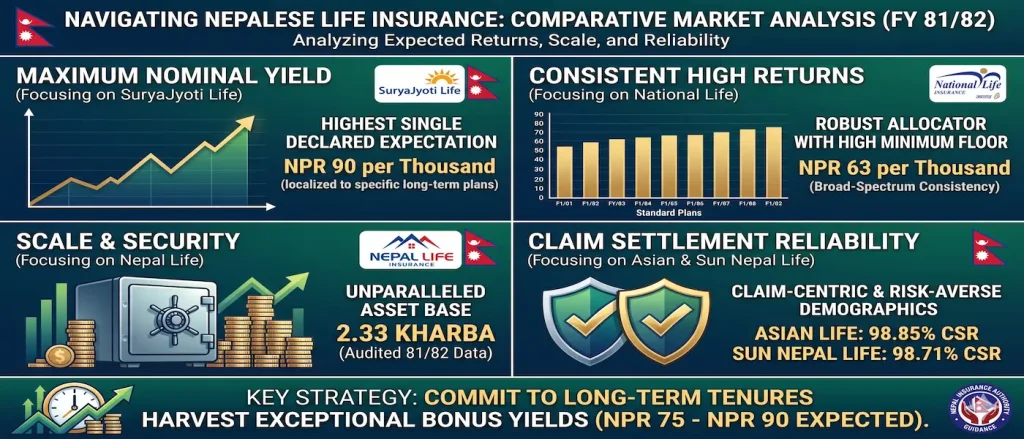
- For Absolute Maximum Nominal Yield: SuryaJyoti Life commands the highest single declared expectation at NPR 90 per thousand (localized to specific long-term plans).
- For Consistent, Broad-Spectrum High Returns: National Life Insurance emerges as the most robust allocator, with a high minimum floor of NPR 63 across standard plans.
- For the Ultimate Blend of Scale and Security: Nepal Life Insurance offers extremely competitive rates backed by an unparalleled 2.33 Kharba asset base (Audited 81/82).
- For Risk-Averse, Claim-Centric Demographics: Asian Life (98.85% CSR) and Sun Nepal Life (98.71% CSR) present the most compelling holistic value propositions.
As the market continues to mature under the data-driven guidance of the Nepal Insurance Authority, rational policyholders are advised to recognize the true cost of liquidity. Committing to extended, multi-decade tenures remains the single most optimal mathematical strategy to successfully harvest the exceptional NPR 75 to NPR 90 bonus yields expected in the Nepalese market.
Not sure which plan fits your budget? Use our Decision Engine to find your ideal match.
