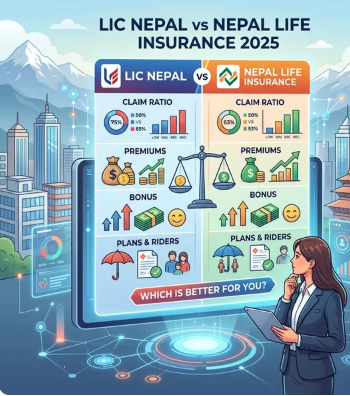
This is one of Nepal’s most-searched insurance match-ups, and for good reason: both LIC Nepal and Nepal Life are large, long-established names that pay claims at scale. But they are built differently. One carries the brand of a foreign parent; the other is the biggest domestic insurer in the country. The right answer depends on what you are buying for, not on a single headline number.
A note on the figures below. The financial numbers (claims, life fund, market share) come from the Nepal Insurance Authority (NIA) Annual Report for FY 2081/82. The claim ratio is a figure we derive from NIA’s published claims-paid and claims-outstanding amounts; NIA does not publish a per-company settlement rate. Plan names and bonus rates come from each insurer’s own product pages. We do not print sample premiums here, because the premium you pay depends on your age, sum assured and term — use the calculator for your own figure.
The Short Answer
| If this matters most to you… | Lean toward… |
|---|---|
| A slightly higher derived claim ratio | LIC Nepal (92.69% vs 90.54%) |
| A foreign-parent brand behind the policy | LIC Nepal (LIC India) |
| The largest domestic insurer by scale | Nepal Life (biggest market share and life fund) |
| The insurer that pays the most claims by value | Nepal Life (NPR 19.20 billion in FY 2081/82) |
| Entry age above 60 | Nepal Life (up to 65, vs LIC Nepal’s 60) |
| A policy term longer than 25 years | Nepal Life (up to 35, vs LIC Nepal’s 25) |
| Fully Nepali ownership | Nepal Life |
Side by Side
| LIC Nepal | Nepal Life | |
|---|---|---|
| Type | Foreign branch (LIC India joint venture) | Private, fully Nepali-owned |
| Market share (premium) | 10.98% | 26.48% (largest in Nepal) |
| Life fund | NPR 1.33 kharba | NPR 2.33 kharba (largest in Nepal) |
| Claim ratio FY 2081/82 (our derived) | 92.69% (rank #8 of 14) | 90.54% (rank #9 of 14) |
| Claim ratio FY 2080/81 (our derived) | 96.40% (declining) | 90.04% (improving) |
| Total claims paid FY 2081/82 | NPR 12.59 billion (Rs. 1,259 crore) | NPR 19.20 billion (Rs. 1,919.65 crore) — highest in Nepal |
| Maximum entry age | 60 years | 65 years |
| Maximum policy term | 25 years | 35 years |
| Critical Illness rider | Not offered | Available |
Factor by Factor
1. Claim settlement — read it honestly
| LIC Nepal | Nepal Life | |
|---|---|---|
| FY 2080/81 (derived) | 96.40% | 90.04% |
| FY 2081/82 (derived) | 92.69% | 90.54% |
| Direction | Down | Up |
| Our derived CSR rank | #8 of 14 | #9 of 14 |
On the ratio alone, LIC Nepal is a touch higher. But two things deserve context before you treat that as decisive.
First, this is a ratio we derive (claims paid divided by claims paid plus outstanding) from NIA’s two published amounts. It is amount-based, and it does not count claims that were rejected, because NIA does not publish rejections per company. So read it as “share of claim value already settled at year-end,” not as “share of claims approved.”
Second, scale matters here. Nepal Life paid NPR 19.20 billion in claims in FY 2081/82, more than any other insurer in Nepal by a wide margin, and it carries the largest policyholder base in the country. A bigger book means more claims sitting in the pipeline at any year-end, which mechanically pulls an amount-based ratio down even when nothing is being denied. Its ratio also rose year on year, from 90.04% to 90.54%. LIC Nepal’s higher 92.69% came alongside a fall from 96.40% the year before — worth watching, though both insurers remain solid claim payers. For a deeper explanation of how this metric is built, see our claim settlement ratios guide.
2. Bonus rates — compare the plan, not the company
Both insurers sell many plans, and each plan declares its own bonus. A single “company bonus rate” is misleading, because the number you actually earn is the rate on the specific plan you buy. Here are each insurer’s flagship endowment rates for FY 2081/82, for orientation only:
Not sure which plan fits you? Answer 5 questions and get a personalised match.
Find My Plan →| LIC Nepal | Nepal Life | |
|---|---|---|
| Flagship endowment plan | Jeevan Labh | Sunaulo Bhabisya |
| Endowment bonus (per 1,000 sum assured) | Rs. 49 to Rs. 65 | Rs. 60 to Rs. 65 |
| Whole-life plan | New Jeevan Tarang | Anmol Jeevan |
| Whole-life bonus (per 1,000 sum assured) | Rs. 50 to Rs. 55 | Rs. 60 to Rs. 82 |
| Money-back plan | Dhan Bristi | Naulo Dhanbarsha |
Do not stack these into a “best bonus” verdict. The plans differ in term, premium-paying period and structure, so the rates are not strictly comparable line for line, and both insurers run several other plans at different rates. The honest takeaway: when you have chosen a plan type, compare the rate on that plan at each insurer. Our bonus rates guide lists the latest declared rates across all 14 insurers.
3. Entry age and policy term
| LIC Nepal | Nepal Life | |
|---|---|---|
| Adult entry age | up to 60 years | up to 65 years |
| Policy term | 5 to 25 years | 5 to 35 years |
This is the clearest practical split between the two. If you are between 61 and 65, Nepal Life will cover you and LIC Nepal will not. If you want a long savings horizon — say a 30-year endowment to mature near retirement — Nepal Life can write it, while LIC Nepal caps the term at 25 years. (Both insurers also write child plans with younger entry ages; the figures above are the adult envelope.)
4. Riders, loans and plan range
| Feature | LIC Nepal | Nepal Life |
|---|---|---|
| Accident benefit rider | Yes | Yes |
| Disability rider | Yes | Yes |
| Critical Illness rider | Not offered | Yes |
| Policy loan | Yes (after 3 years) | Yes (after 3 years) |
| Surrender value | Yes | Yes |
| Money-back plan | Dhan Bristi | Naulo Dhanbarsha |
The one rider difference that may matter: Nepal Life offers a Critical Illness rider, while LIC Nepal’s published rider set covers accident and disability but not critical illness. If a critical-illness add-on is part of your plan, that is a point for Nepal Life. On loans and surrender the two are equivalent — both allow a policy loan after three years and both build a surrender value.
5. Premiums
We do not quote sample premiums for either insurer, because a premium is meaningless without your age, sum assured and term — and because, for the same inputs, the two sit very close on price. Choose on claim record, plan fit and bonus, then get the exact figure for your own profile from our premium calculator, which prices both insurers side by side.
Which Buyer Should Choose Which
Lean toward LIC Nepal if:
- A foreign-parent brand (LIC India) behind your policy gives you confidence
- You want the higher of the two derived claim ratios (92.69% vs 90.54%)
- You are buying before age 60 and a term of 25 years or less fits your goal
Lean toward Nepal Life if:
- You want the largest domestic insurer by market share and life fund, with the highest annual claim payout in Nepal
- You are between 61 and 65, or want a policy term longer than 25 years
- You want a Critical Illness rider option
- Keeping your premium with a fully Nepali institution matters to you
The Bottom Line
This is not a contest between a good insurer and a bad one. It is a choice between a foreign-parent brand and domestic scale. LIC Nepal offers the backing of LIC India and a marginally higher derived claim ratio. Nepal Life offers the largest market share and life fund in the country, the highest total claims paid of any insurer, wider entry-age and term flexibility, and a Critical Illness rider option.
Match the company to your situation — your age, the term you need, the riders you want — rather than to one headline number. Then run both through our compare plans tool with your exact age, sum assured and term to see them side by side.
Data sources: Financial figures (claims, life fund, market share) from the NIA Annual Report FY 2081/82, Schedules 14 and 15. The claim ratio is our own amount-based calculation (claims paid divided by claims paid plus outstanding); NIA does not publish a per-company settlement rate, and the figure does not count rejected claims. Plan names and bonus rates are from each insurer’s own product pages, FY 2081/82. We do not publish sample premiums; use the calculator for a figure based on your own profile. See full disclaimer.